
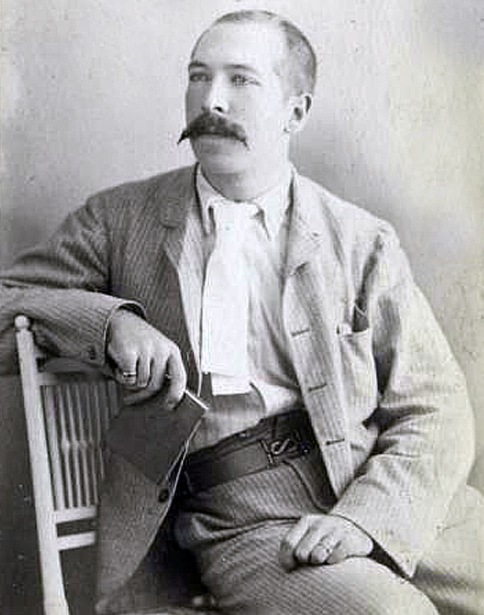
Hedley Churchward (Mahmoud Mobarek) (1862, Walmer, Kent – 28 August 1929, Johannesburg) was an English painter and theatrical set designer. After converting to Islam, he became known as Al-Hajj Hedley Churchward, or Mahmoud Mobarek, and in 1910 was the first recorded British Muslim to perform the Hajj pilgrimage to Mecca. These pages will present research and archive material curated by Ian Waugh, a historian and relative of Churchward. To contact this website, click here.
This website was created: 25 September 2025.
Introduction
While scattered rumours speak of English Crusaders who abandoned their cause to embrace Islam, or of sailors in Ottoman service who may have glimpsed the Holy Cities centuries ago, the first fully recorded account of Hajj by a British Muslim belongs to the Edwardian era. In 1910, Hedley Cole Churchward, a London artist turned devout Muslim, became the first documented Englishman to leave a detailed testimony of his pilgrimage to Mecca. Known in the Muslim world as Mahmoud Mobarek, his life bridges the gap between Victorian theatrical culture and the spiritual heart of Islam.
1. Family Origins and Early Influences
Churchward was born in 1862 into an ancient English family whose ancestral home was reputed to be the second oldest continuously inhabited house in Britain. His father prospered in Aldershot, the military town, supplying the needs of regimental circles and earning widespread respect. Through these connections, young Hedley was introduced to Queen Victoria and the famed philanthropist Baroness Burdett-Coutts.
Gifted in art from childhood, he trained as a painter and soon gravitated toward scenic design for the theatre. This was no minor profession: in the 1880s, West End scene-painters were sought-after craftsmen, and Churchward became a familiar figure backstage in Drury Lane. His patrons and associates included the poet Tennyson, painters such as Millais and Leighton, and the dazzling celebrity Lillie Langtry. By his early adulthood he was well connected, prosperous, and part of London’s cultural elite.
2. Encounters with Islam: Spain and Morocco
Travel broadened his horizons. A visit to Spain exposed him to the surviving splendours of Moorish architecture — the Alhambra, Córdoba’s mosque-cathedral, and other reminders of al-Andalus. Inspired, he crossed into Morocco, a land where Islamic life still moved to its own rhythms, relatively untouched by Western intrusion.
There he witnessed the gentleness of Muslim daily practice, the dignity of prayer, and the harmony of art and belief. Repeated journeys deepened his admiration until, in an announcement that startled his family, he declared himself a Muslim.
3. Cairo and Al-Azhar
Determined to ground his new faith in knowledge, Churchward settled in Cairo and studied at Al-Azhar University, the world’s foremost institution of Islamic learning. His progress was rapid. He mastered enough Arabic to deliver Friday sermons, and his scholarship earned him appointment as a lecturer in Sira (the biography of the Prophet Muhammad) at the Qadis’ Academy.
For a recent convert from England, this was a remarkable achievement, signalling the seriousness of his conviction and the respect in which he was held by scholars.
4. South Africa: A Bridge Between Worlds
Financial necessity led him to South Africa, where his artistry and refined manners gained him entry into influential colonial circles. He came to the notice of Cecil Rhodes, who rewarded him with a rare pink diamond.
At the same time, Churchward maintained close ties with local Muslim communities. His intervention with President Paul Kruger secured official approval for the construction of the first mosque in the Witwatersrand goldfields. In this way, he served as a bridge between the white elite and Muslim settlers, respected in both camps.
5. Marriage and the Pull of the Fifth Pillar
Returning to Cairo, now known as Mahmoud Mobarek, he married the daughter of a prominent Shafi‘i jurist of Al-Azhar. He continued teaching, but felt incomplete. Prayer, study, and community life were not enough without the fulfilment of the Hajj. As he later recalled:
“One evening, as I strode along the looming Pyramid in the sunset, and saw the jagged skyline of Cairo behind the dreamy African dusk, I decided to carry through what I had intended to do ever since I turned a Moslem — I would go to the Kaaba at Mecca.”
6. The Cairo Examination
To secure the trust of Ottoman authorities at Jeddah, he required formal endorsement. He stood before Egypt’s Chief Qadi and the visiting Shaykh al-Islam Mehmet Jemaluddin Efendi, the supreme religious authority of the Empire. For three hours they tested him with searching questions. He passed, and was presented with a calligraphed certificate attesting to his sincerity and knowledge — his “passport of faith.”
7. The Journey of 1910
In 1910, after another spell in South Africa, Churchward began his pilgrimage. The route was complex: from Johannesburg to Bombay, where delays with shipping officials stalled him for weeks. Eventually he secured passage on the SS Islamic, a lumbering pilgrim vessel commanded by an irritable Scotsman. Armed with cannon against pirates, the ship crept across the Indian Ocean, stopping at impoverished Gulf ports before labouring up the Red Sea.
On deck, surrounded by Indian pilgrims, he shared meals of curry, joined them in prayer, and watched dolphins dancing beside the hull. At Suakin in Sudan, the British Consul dismissed his plans as impossible. Yet soon after, the vessel anchored off Jeddah.
8. From Jeddah to the Haram
Disembarking in a small boat past a coral-bound Turkish warship, he was admitted without obstruction. He was placed in the care of agents of Sharifa Zain Wali, a Meccan noblewoman whose family of guides (mutawwifs) supervised thousands of pilgrims.
After donning the ihram, he and his party set out by donkey through the desert, Halley’s Comet blazing in the sky above. The silence of the canyon was broken by gunfire as Ottoman troops repelled bandits. Eventually they reached the stone markers of the Haram. His guide prompted him to recite the Fatiha, marking his entry into sacred ground.
9. In Mecca
At last he reached the mansion of the Sharifa, where custom dictated he present a gift — a Gouda cheese from his provisions. From behind her mashrabiya screen she called out her welcome: “Mubarak! Welcome to my house.”
He slept on the roof under the stars, woken at dawn by the mournful notes of Ottoman bugles. After prayers and a breakfast of melons, he followed his mutawwif into the Sacred Mosque, treading flagstones once desecrated idols, and finally stood before the Kaaba — the heart of Islam, and the fulfilment of his life’s spiritual quest.
Conclusion
Hedley Churchward’s journey from Aldershot to Al-Azhar, from Cecil Rhodes’s drawing room to the streets of Mecca, encapsulates the extraordinary breadth of Anglo-Muslim experience in the early 20th century. He remains the first British Muslim to leave a detailed written account of the Hajj, and his story reflects a life lived across boundaries: English and Muslim, artist and pilgrim, colonial outsider and honoured Guest of God.
Who was Hedley Churchward?
He was an English painter and theatrical set designer who converted to Islam and, in 1910, became the first recorded British Muslim to perform the Hajj.
What was his Muslim name?
Mahmoud Mobarek.
Why is he significant?
His 1910 pilgrimage marked a pioneering moment in British Muslim history, and his artistic work reflected cross-cultural influences.
Who curates this research?
The archives are compiled by historian and relative Ian Waugh.